


Forms by @tominator76. Art by @Jazzdotpxl. Under the Occulum brand.
Making the Art
The collection idea was born on May 12, 2026. From the very beginning, I wanted to bring rare sats and art together. More on rare sats in the next section. I had worked on collections before, but I had never explored low-pixel-count art. You might think fewer pixels would make it easier. It does not. The sweet spot for pixel art is usually around 32 by 32 to 64 by 64. Once you drop into the 20s, space for detail disappears quickly, and you have to get creative. We landed on 20 by 20, which is smaller than CryptoPunks at 24 by 24.
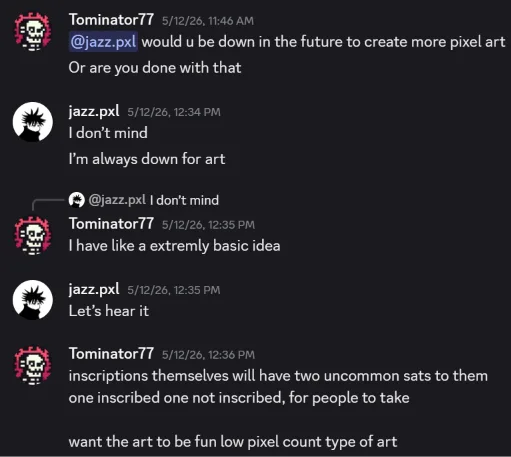
We had the format. The next question was direction. I like going against the grain. I wanted 1/1 pixel art without a rigid theme or a set of rules that would force every piece into the same identity. My thought was simple. Make a lot of 1/1s and create whatever felt right. I shared that idea with friends, and most of them advised against it. They thought a collection with no unifying theme would feel strange.
I sent Jazz hundreds of 1/1 ideas across different categories, but the final choices were his. Many of the categories and pieces came from his own imagination, which only happened because he had the freedom to create what he wanted. By then, I had worked with Jazz for years, and the trust between us was strong. I paid him in full before any work began and did not micromanage the process. Every week or so, I would check in to look at the new pieces and see if anything needed adjusting. Most of the time, nothing did. One detail worth noting, and credit to Jazz: we barely had drafts for Forms. Almost every Form you see is the original.
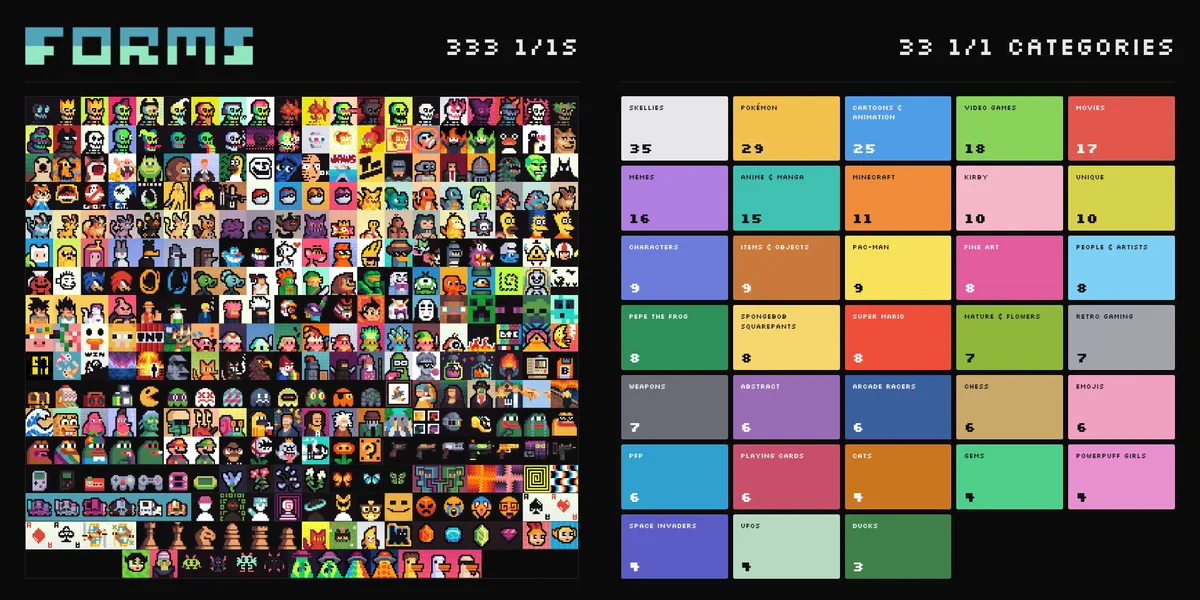
After three months, the collection was finished on August 17, 2026. The art was done, but the work was not. Instead of naming each piece Form #1 or Form #2, I wanted each one to have its own personality. Jazz and I named them one by one. Some names were invented. Others were taken from the characters or movies they referenced.
Once everything had a name, I wanted a simple way to organize the set. I started grouping pieces together. Some groups were large enough to stand on their own, like skellies. Others, especially specific references, were folded into broader categories such as memes and movies. In the end, we had 33 categories of 1/1s, inscribed from largest to smallest, so the collection would stay clean and organized on the chain.
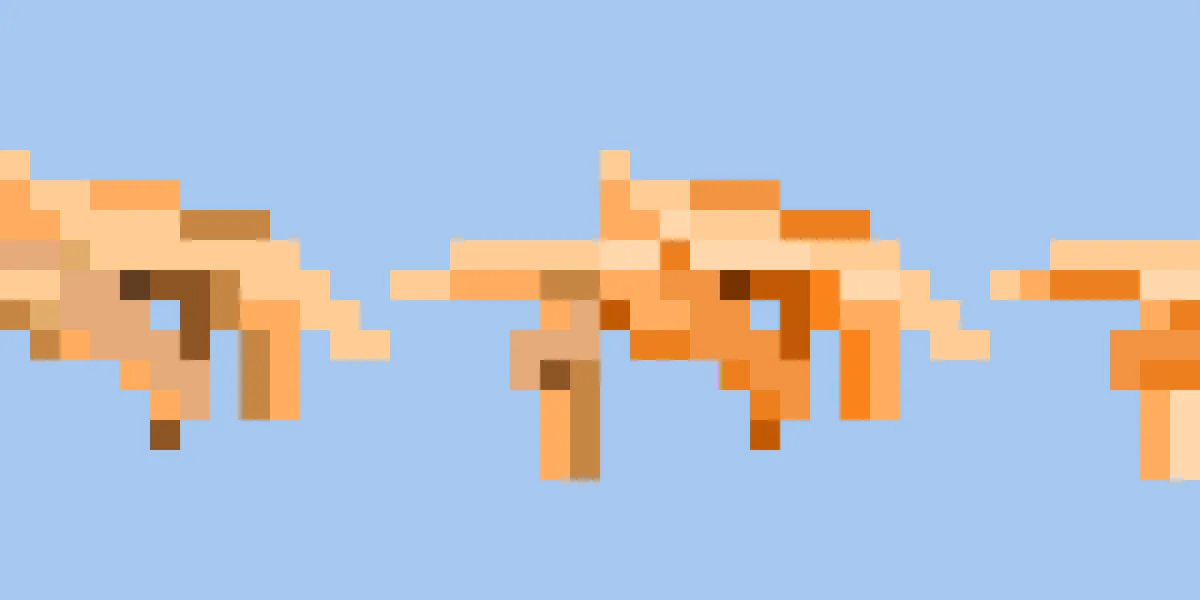
One of the pieces Jazz was working on was Michelangelo’s The Creation of Adam. That piece is extremely hard to pull off in a 20x20 format. I wanted it done in a very specific way and wasn’t a fan of Jazz’s version, so I figured I’d try making a draft of the direction I wanted and send it to him.
I ended up putting so much effort into the draft that I loved it and wanted to include it in the collection. This ended up being the first digital artwork I ever made.
Making this piece gave me a much greater appreciation for pixel artists, especially Jazz, working in such a tiny 20x20 format. It feels a lot smaller when you’re the one actually making the art. I went back and forth over a single pixel and where to place it. I spent so much time on the colors I wanted, trying to separate them so they wouldn’t be too harsh, but you could still see the different parts of the hand.
I couldn’t imagine doing this 332 more times after struggling and spending hours on just one. After I finished, my head even hurt from the frustration and staring at pixels for so long.
Explaining Rare Sats and Their Value
Ordinals track individual sats, the smallest unit of a bitcoin (1 BTC = 100M sats), allowing data to be inscribed directly onto them. Because each sat is uniquely identifiable, rare sats function just like rare collectible coins.
Forms has Block 9 and Uncommon sats
- Block 9: Oldest circulating sats in Bitcoin history, from Satoshi’s first transaction to Hal Finney. Hal famously regretted spending these sats.

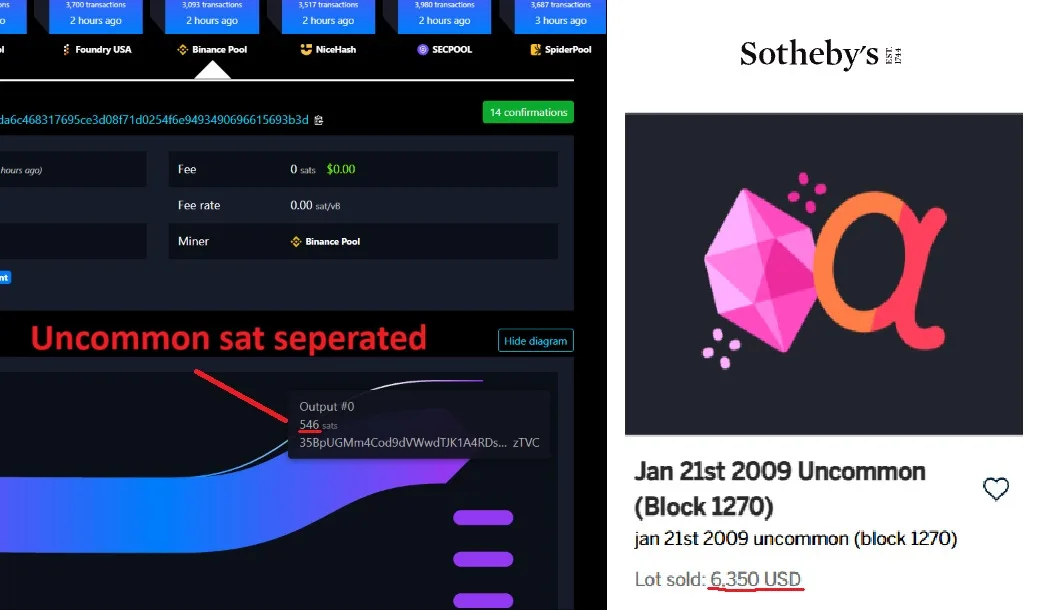
- Uncommon: The 1st sat of each block (~1M total). Isolated by miners, vaulted by exchanges, and auctioned at Sotheby’s for thousands.
The Inscription Buffer
Moving an Ordinal requires a ~330 sat buffer. Most projects use common filler sats. Forms packs the entire buffer with rare sats, adding a built-in floor.
Hypothetically (not current prices)
- A Form with 333 B9 sats (valued $1 each) = $333 floor
- A Form with 2 Uncommon sats (valued $150 each) = $300 floor
Instead of 1 rare sat per piece, Forms holds 60,273 B9 sats and 303 Uncommon sats across the entire collection, directly anchoring digital art to scarce Bitcoin history.
333 1/1 rare sats
First Inscription (Ghost Skelly)
- Alpha Uncommon - Block 99090 Dec 23, 2010
- Uncommon - 2018 Luck 8
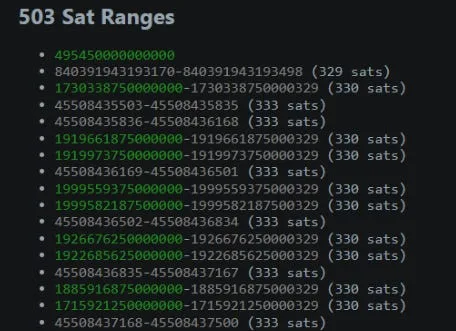
B9 sat ranges
- 150x Pieces with 333x B9 455x sats
45508435503-45508480553 (45,051 sats)
45508480884-45508485782 (4,899 sats) - 31x Pieces with 333x B9 4510x sats
45108465227-45108475549 (10,323 sats)
Uncommon sats
- 150x Pieces with 2x Uncommons ranging from 0-6 Luck
10x 2016 | 23x 2017 | 16x 2018 | 14x 2019 | 33x 2020 | 46x 2021
34x 2022 | 33x 2023 | 10x 2024 | 31x 2025 | 50x 2026
Last Inscription (Cool Duck)
- Omega Black Uncommon - Block 69600 Jul 22, 2010
- Uncommon - 2023 Luck 7
On-Chain Art and Inscribing
I had just finished the art, metadata, and gathering of rare sats for Forms. All Forms combined totaled 69.3 KB (noice). We were finally ready to inscribe.
I knew I wanted the collection to have parent-child inscriptions, metadata, and rare sats, so I reached out to @gm7t2 to see if he could be our developer. He said yes immediately, then told me he needed to write a new program to allow two different sat buffers in the same transaction: 333 and 660.
After the new script was done, I sent Greg all our rare sats along with the metadata and inscribing info. I told him I wanted to inscribe all 33 1/1 categories in order, switching from Uncommon sats to B9 sats. He got to work and built one huge UTXO, a large group of sats, so the rare sats were in exact positions needed to inscribe in the order I requested.
Once that was done, we created a few batches of test inscriptions. I probably went over all 333 pieces ten times to make sure the order was correct and every name was accurate. I caught a few errors: some names, one ordering issue, and one piece that needed a background because it was hard to see without one.
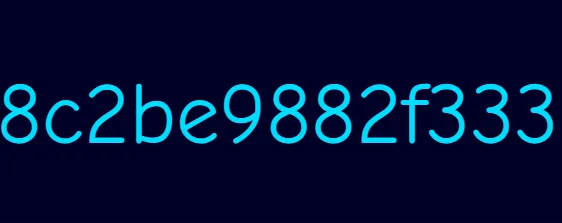
Greg then asked if I wanted a custom ID at the end of each inscription. He could do eight characters, limited to numbers and the letters a to f. I decided on 9882f333: 9882 for our parent number, f for Forms, and 333 for the supply. We generated millions of pre-mined transactions to see which ending I liked best. The coolest one we found was 2be9882f333. I was talking to one of my friends, and he said it meant “2be”, and I instantly wanted that ending.
Originally, I wanted to just inscribe as fast as possible, but then I realized a golden opportunity. Block 963,369 was a few days away, and I’m a little geek for numbers, as you can probably tell from reading this far. Why 963,369? It is a palindrome of 963 followed by its reverse. The first three digits fall in order by steps of 3, and every digit is divisible by 3. From 100,000 to 999,999, only 48 palindromes have every digit divisible by 3, and only 3 of those also have the first three digits running in ascending or descending steps of 3 the way 963,369 does.
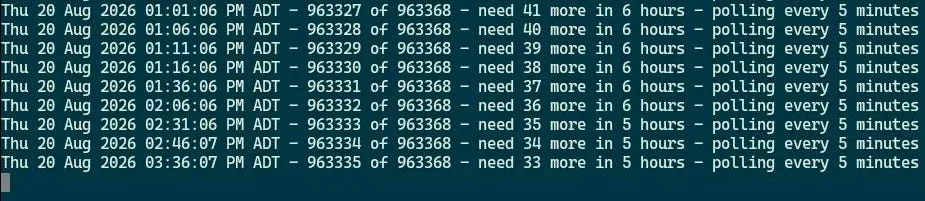
Greg had to run a script to track each block, and once we hit block 963,368 he submitted our inscribing transaction. We were not guaranteed to land in that block. A block can be mined so fast that the transaction never makes it in, or the block can fill and push us to the next one. Fees can also spike and kick us out. We submitted at 3.33 sat/vB.
Waiting for that block was stressful. It was the day Bitcoin broke past $70,000, and the mempool was hot. Usually it sits around 0.5 to 1 sat/vB; that day it was 2 to 3 sat/vB. My luck is always bad whenever I try to do something on-chain, and Forms was no different. The block we submitted was, of course, a 30-minute block, and fees jumped from 0.5 sats to 2.2 sats. I really wanted to keep our fee rate at 3.33 to keep the theme. Just as we were about to raise the rate, the block passed.
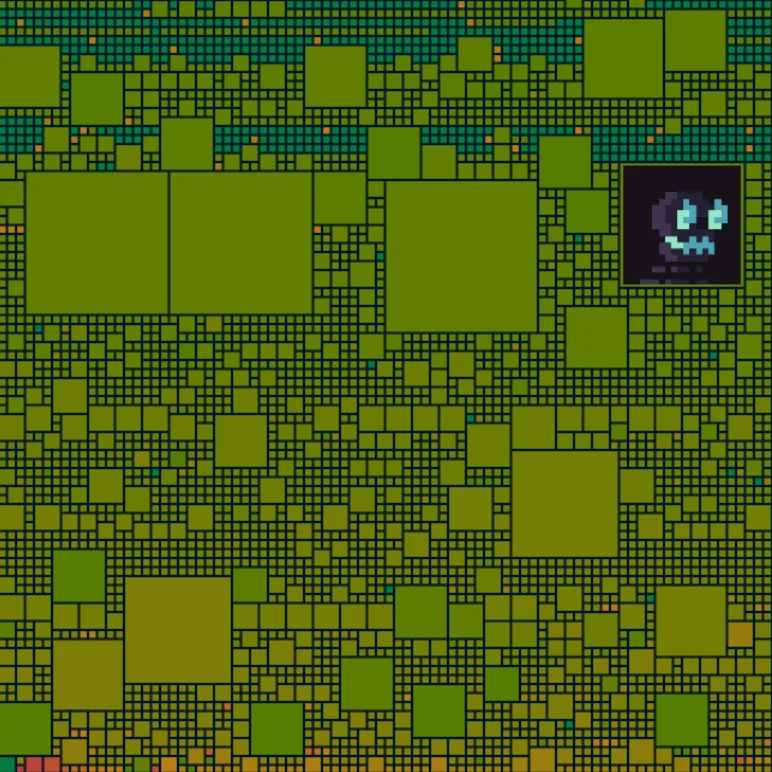
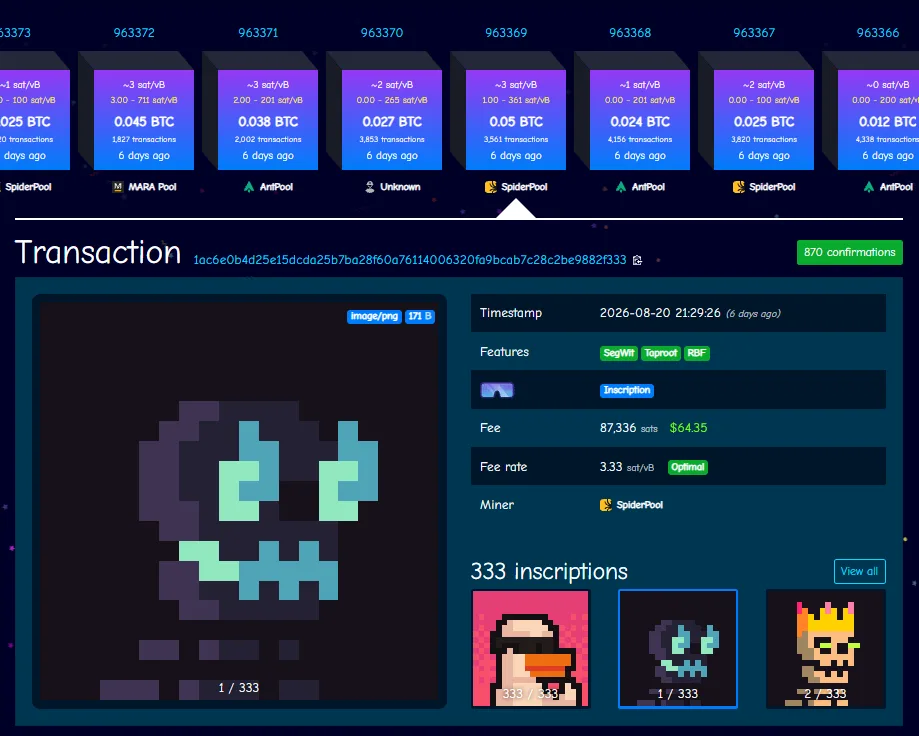
Because the base fee rate was so high for block 963,369, all other ordinal image inscriptions got pushed to the next block. Forms ended up being the only image inscription in the entire block. Block 963,369 had a total of 340 inscriptions, of which 333 were ours, and the other 7 were text. Thankfully, everything went smoothly and according to plan.
I want to thank Greg again for going above and beyond with Forms. He wrote custom code just for us and added suggestions that made the collection even more fun. And if you have not noticed already, we wanted the number 3, or a number divisible by 3, everywhere: total file size, fee rate, the blocks of our first and last rare sat, number of categories, sats per inscription, inscription IDs, and most importantly, the block we inscribed on.
By embedding the number 3 into everything, from file sizes and fee rates to the very block we inscribed on, this numerical rhythm becomes far more than an aesthetic choice. It is the defining and permanent on-chain signature of Forms, binding the art, the code, and our entire single block mint into a unified whole.
Releasing Forms
From day one, Forms was meant to benefit the people who supported me the most and have been collecting for years. I never promised holders utility or a reason to hold. My goal was simply to get people to hold what they like, without short-term conditions attached.
After Occulum minted, I created a channel with no info and no announcement, just a place to post your wallet. Why that instead of a snapshot? I wanted to reward active holders. If you could not spend a minute posting your wallet during a two-month window, you probably would not care much about what I’m doing. Occulum’s supply is also 1,111, so it would have been impossible to give spots to every holder for something with only 333 spots.
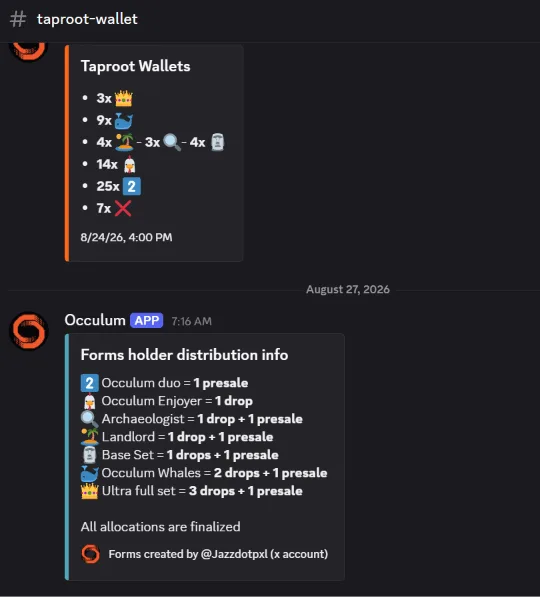
We wanted to allocate around one-third of Forms to Occulum: half as free airdrops sent after sellout (53 TXs sent out), and the other half as a paid presale mint. The more people who submitted, the more I had to tweak the numbers for each role. Those roles are meant to encourage collecting. For example, the landlord role means you hold 3 out of 100 land pieces from one of our mini collections. Built into Forms is a strong core community from Occulum.
The next third of the supply was for X. We hand-picked around 100 people from different pushes. Some were specific post challenges. Others were asked to PFP a Form and talk about us. The one I prioritized most was a group chat of people with Forms PFPs. I wanted to talk and vibe with people in that chat. People who were genuine and treated me like a human got a spot. People who spammed “wen WL” and tried to grind for one did not. You had to be filtered through me (Tominator). Nobody else was hand-picking spots.
The last third went to collabs. I mainly collaborated with communities outside of Ordinals. I wanted to bring people back and onboard them. For GTD WL, we picked the top communities and gave each around 2 to 5 spots, with a strict no team-spot policy. Some CMs ignored that and took a spot for themselves. If they did, we excluded it so the community kept fewer spots than they would have had by following the rule.